Video game, immersive installation, 2025
Indulto is an interactive piece in three acts. Each act deliberately subverts the codes of traditional video games, and more specifically the mechanics of tutorials and boss fights. Here, interaction serves only to expose the fiction of choice and the fascination with codified violent rituals.
The title itself, indulto, refers to a rare grace in bullfighting, when a bull is spared in recognition of its courage. Yet even this supposed gesture of mercy remains paradoxical: in the end, the sacrifice is inevitable.
In Indulto, the user advances toward an unavoidable confrontation using a game controller. As progression unfolds, the attack combos to be learned become increasingly absurd, unreadable, and unachievable. When the battle finally begins in the center of the arena, the camera looks away. The clash takes place off-screen. And when it returns, only one decision is offered, to kill or to spare, both leading to the same conclusion: the death of the bull, under the thunder of applause of the crowd.
The work seeks to expose the spectacle that manufactures meaning out of violence, to highlight the illusion of free will when everything has already been scripted, and to question the belief that a violent act becomes acceptable if it is beautiful enough, if it is performed with sufficient grace.




Text by Ingrid Luquet-Gad for Indulto, solo show at New Galerie:
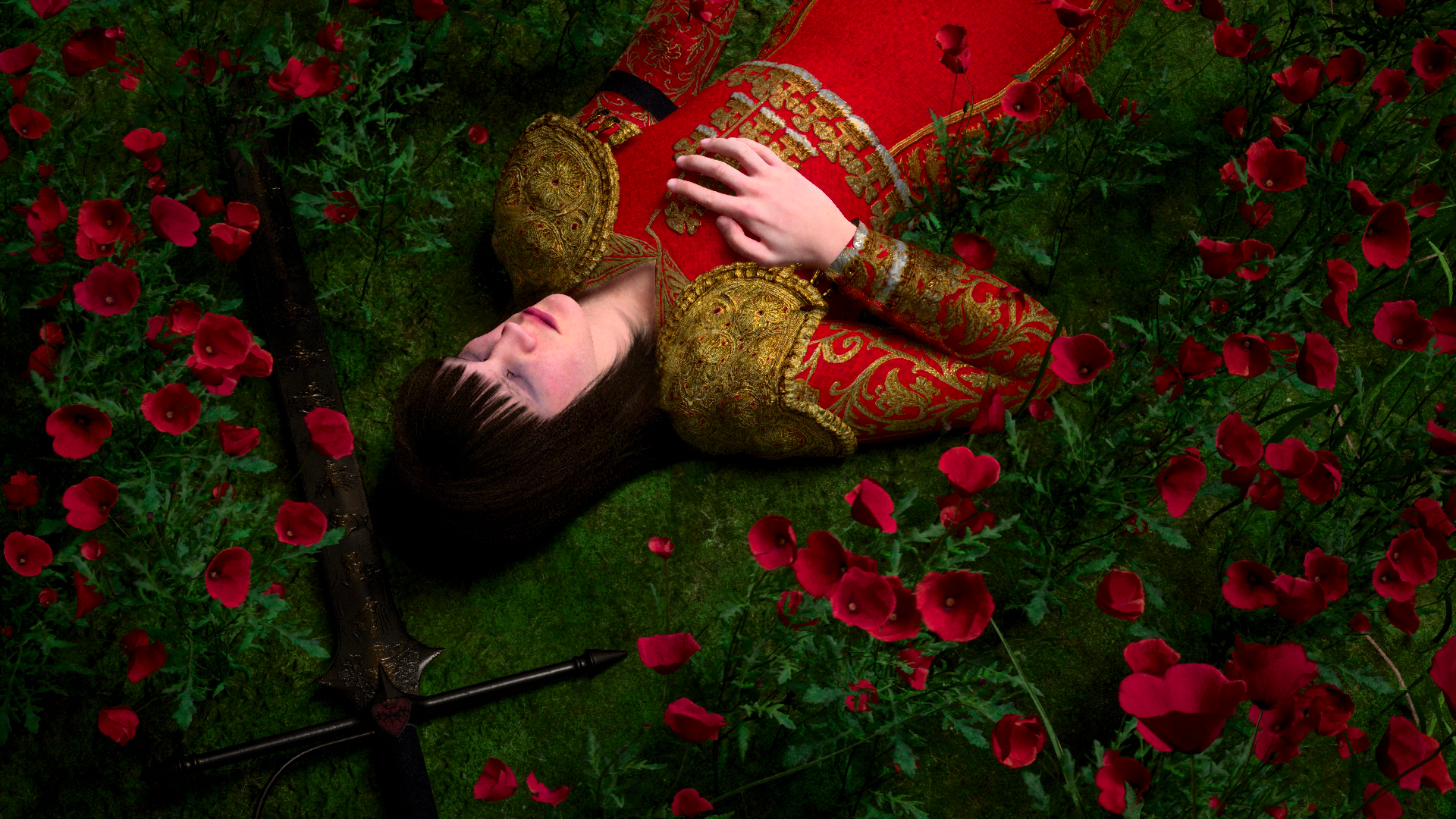
In our post-transcendent world, the deus ex machina has lost all credibility. Those miraculous interventions from above belong to theater, a narrative form tied to sensory experiences unlike our own. Yet in video games, the medium that defines our contemporary moment, fate can still descend from the sky. Mélanie Courtinat’s game Indulto opens with precisely this gesture: a caparisoned bull-God tears through the clouds and crashes to earth. An Edenic clearing of flowers breaks its fall. A sword tumbles loose. Our quest begins, and so does the game.
For her first solo exhibition at New Galerie, the 1993-born artist presents a new game. Its title refers to the Spanish bullfighting term for a pardon granted to the animal at the audience’s request. Players assume the role of a torero, an androgynous, elegant figure fated to confront the fallen beast. What follows is a double education. First, players learn the familiar conventions of the boss fight: Walk, Run, Jump through moss-covered landscapes in search of the legendary sword. But gradually, a second lesson emerges, one drawn from tragic drama itself. Screen by screen, players recognize that their choices are scripted, their agency circumscribed, their free will an illusion.
The game refuses escape from the start. Two buttons appear: “Play” and “Quit.” Only the first functions. The second simply confirms that desertion is impossible. A long corridor stretches toward the arena. Along the way, prompts teach increasingly elaborate attack combinations: Rear finishing blow, Sliding dodge, Fatal combo—escalating toward absurdity until the genre’s smooth mechanics begin to falter. The climactic confrontation itself happens offscreen, replaced by a final choice: “Spare” (X) or “Kill”. Yet this choice is false as the bull dies regardless, killed either by the player or by a crowd that refuses mercy.
This ending revives the “tragic status of the agent” from ancient narrative while exposing gameplay itself as voluntary servitude: the acceptance of rules imposed by others. But Courtinat’s project extends beyond adapting tragic or existentialist themes. Video game agency raises questions entirely its own. Throughout her practice, composed exclusively of immersive digital works, the artist builds worlds and deconstructs conventions in equal measure. Her sustained attention to player position, cinematic language, and interactive systems produces melancholic universes marked by layered temporalities and sudden eruptions of violence or luminosity. The gesture, however, is twofold. In transforming spectators into players, she also critiques the art world’s own protocols—spaces where we perform viewing as much as we enact parasocial relations.
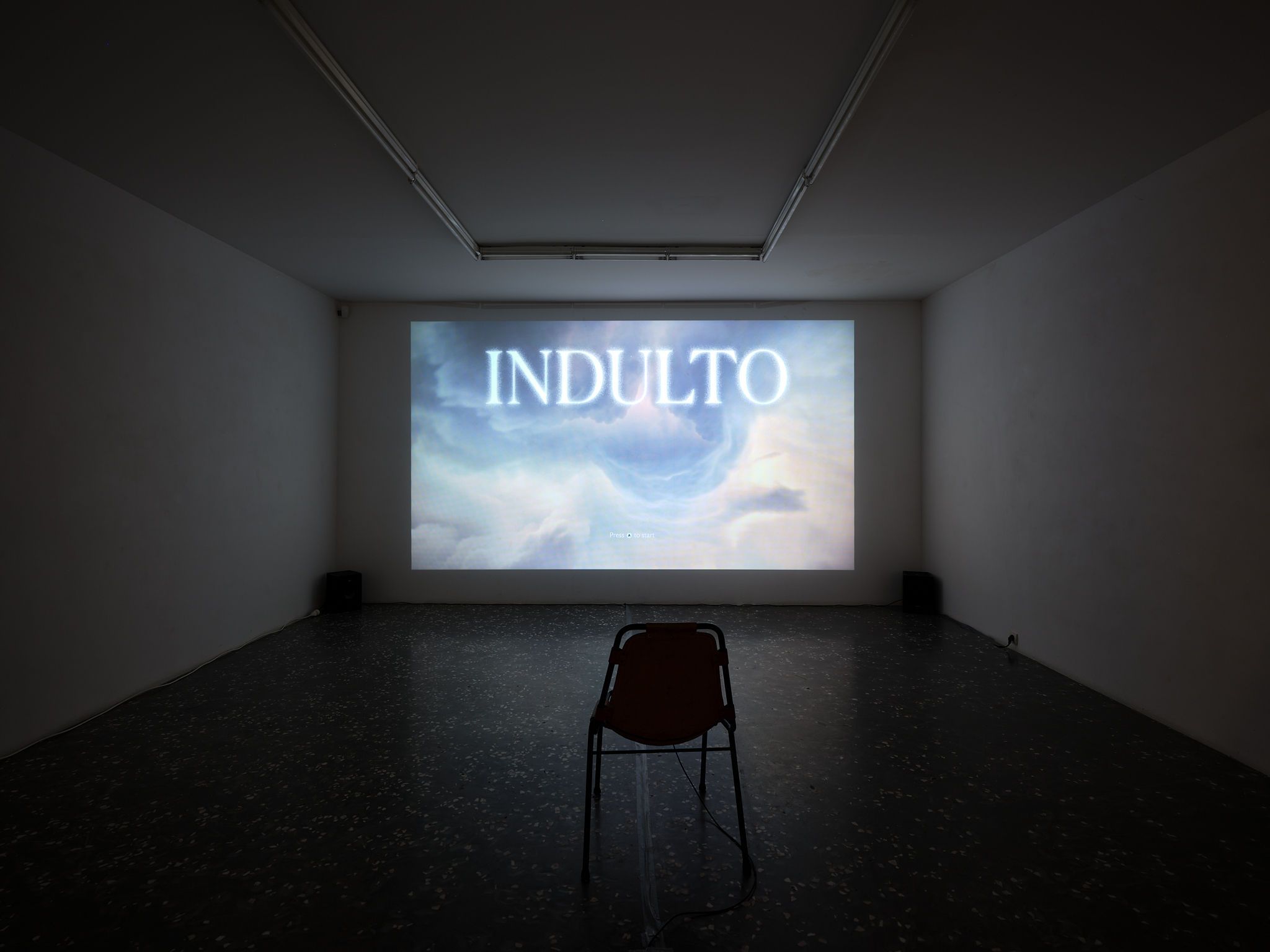
At New Galerie, the game’s presentation is deliberately spare: a chair, a controller, a projection. An unadorned invitation to confront destiny and collective judgment. Downstairs, a video monitor displays the two protagonists frozen in idle stance, which designates the looping animation that plays when no one engages. In The Language of New Media (2001), Lev Manovich identifies navigable space precisely as what is specific to video games. He writes: “In contrast to modern literature, theater and cinema, which are built around psychological tensions between characters and movement in psychological space, these computer games return us to ancient forms of narrative in which the plot is driven by the spatial movement of the main hero [...].”
Thus, Indulto’s deflated heroism makes room for contemplation within a medium still synonymous with action.